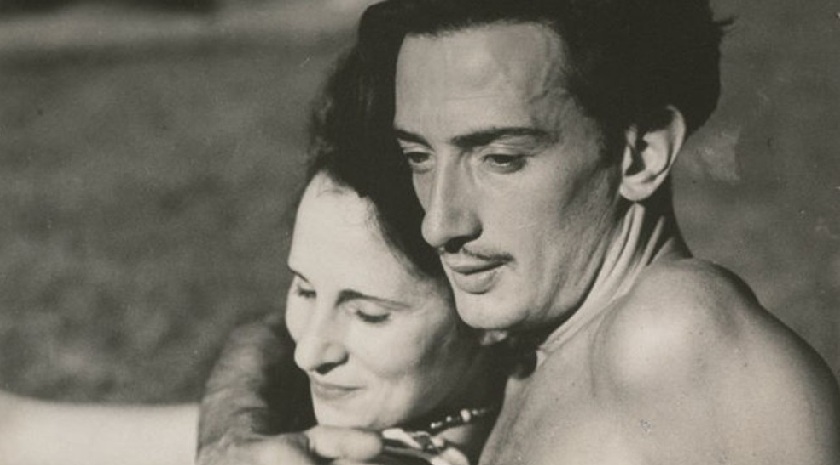
“I love Gala more than my mother, more than my father, more than Picasso, and even more than money”.
Salvador Dalí
.
This week in 1982, the 10th of June, the clock chimed for the final time in the coastal sanctuary of Portlligat, marking the departure of a woman who was not merely a witness to art history but its absolute architect.
Elena Ivanovna Diakonova, known to the world, mythically, as Gala, passed away, leaving the Master of Surrealism utterly unmoored. She was buried in the crypt of her gothic castle in Púbol, dressed in a red Dior gown, fitting for a woman who ruled Dalí’s universe with a powerful, determined character and an incredible artistic intuition.
Without Gala, Salvador Dalí would likely have remained a brilliant but clinical diagnostic case, a victim of his own paralysing neuroses. She was his Gradiva, she who steps forward, the heroine of Wilhelm Jensen’s novel who cures the protagonist’s madness. For Dalí, Gala was the anchor to a reality he feared, and the celestial gateway to the dreams he painted.
Born in Kazan, Russia, in 1894, Gala’s early life was defined by intellectual curiosity and an unyielding survival instinct. When tuberculosis struck her at nineteen, she was sent to the Clavadel sanatorium in Switzerland. It was here, amidst the pristine alpine air, that her destiny as a muse ignited. She met her first husband, the French poet Paul Éluard, introducing him to the Russian literature that shaped her soul and helping him craft his earliest poetic voice.
By the 1920s, Gala was the undisputed queen of the Parisian Surrealist circle. Poets like Max Ernst and René Char were hypnotised by her gaze. Yet, her ultimate transfiguration occurred in the summer of 1929 in Cadaqués, when she looked upon a young, eccentric, and hysterically laugh-prone Catalan painter named Salvador Dalí.
Though she was ten years his senior and married, the collision of their minds was instantaneous and cosmic. Dalí recognised her immediately as the entity he had spent his youth imagining.
In his 1942 autobiography, The Secret Life of Salvador Dalí, the artist vividly recalled the precise moment he realised Gala was the savior of his sanity: “She was destined to be my Gradiva, the one who moves forward, my victory, my wife. She cured my madness. Thanks to her, I stopped laughing like a madman and learned to smile at life. She was the absolute remedy that saved me from a catastrophic fate”.
The marriage between Gala and Dalí defied every conventional bourgeois boundary. Gala was fiercely pragmatic, a brilliant strategist who took the chaotic, unmarketable extravagances of Dalí’s mind and transformed them into an international luxury brand. While Dalí painted, Gala courted collectors, negotiated contracts, and fiercely protected his studio from distractions.
Their bond was so absolute that by 1950, Dalí legally altered his identity as a painter, fusing their names into a single signature. As he noted: “By signing my works as Gala-Dalí, I am merely naming an existential truth, because I would not exist without my twin Gala”.
Yet, as the decades advanced, their relationship evolved into an intricate courtly ritual. In 1968, Dalí purchased the medieval Castle of Púbol for her, a real estate manifestation of courtly love. Gala accepted the gift on one astonishingly surreal condition: the artist could visit her there only if he requested prior written permission. Far from offending Dalí, this boundary fueled his romantic obsession; he viewed it as a sublime game of submission to his sovereign queen.
In The Secret Life of Salvador Dalí, he mused on her multifaceted nature and the endlessly affectionate, almost manic taxonomy of names he invented for her: “I name my wife: Gala, Galushka, Gradiva; Oliva, for the oval shape of her face and the colour of her skin; Oliveta, diminutive for Olive… I also call her Lionette, because when she gets angry she roars like the Metro-Goldwyn-Mayer lion”.
Gala’s physical form became the sacred geography of Dalí’s greatest masterpieces. He painted her not merely as a model, but as a divine principle. In Leda Atomica (1949), she is the mythological queen suspended in a state of perfect, atomic weightlessness, untouched by the world. In The Madonna of Port Lligat, she is elevated to the Catholic matriarch of the universe, cosmic and serene. Even in his three-dimensional bronze sculptures, such as the Unicorn, Dalí carved a heart-shaped opening through a stone wall, a direct metaphor for Gala’s ability to pierce through his defensive exterior and heal his soul.
The tragedy of Gala’s death in 1982 proved just how visceral their codependency was. When her breath ceased, Dalí’s artistic motor died with her. He secluded himself in the darkness of Púbol Castle, refusing to eat or drink, literally starving himself in a desperate bid to join his twin.
When a catastrophic bedroom fire injured him in 1984, forcing his relocation to the Torre Galatea in Figueres, he was a ghost of his former self, a king without his crown, a creator stripped of his creation.
On this anniversary of her passing, we look beyond the canvas to the woman who pulled the strings of the 20th century’s greatest artistic spectacle. Gala Dalí was never a passive model waiting to be immortalised. She was the catalyst, the strategist, and the supreme force of nature that allowed Surrealism to conquer reality.