
“I think that dreams are a gateway to our unconscious mind… By paying attention to our dreams and exploring their symbolism, we can gain a deeper understanding of our subconscious thoughts and desires”.
Salvador Dalí
.
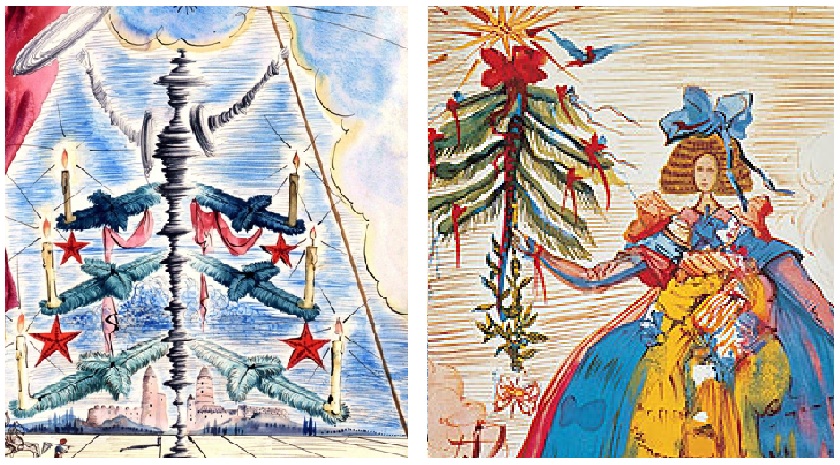
Dalí’s Christmas Cards, particularly those created for Hoechst Ibérica between 1958 and 1976, represent a fascinating and often underestimated chapter of his production, where the traditional Christmas Tree transforms into a powerful psychoanalytical and cultural symbol.
For Dalí, the holiday season was not merely a religious occasion, but an “open-eyed dream” rooted in the wonder and nostalgia of childhood. One of the most intriguing compositions, often associated with the 1959 Hallmark production or his Spanish series, presents the Christmas tree as a metamorphic entity.
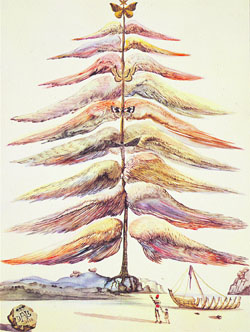
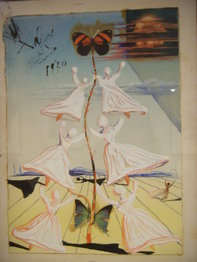
In one of the cards, the tree is not made of pine, but of a cascade of angel wings or butterflies soaring up into a conical structure. In place of the traditional Star of Bethlehem, a single, large butterfly hovers at the summit.
.
.
The butterfly is one of the most compelling symbols in Dalí’s universe, representing transformation, rebirth, and the soul emerging from the earthly chrysalis. The butterfly atop the tree is not merely a star, but the spiritual zenith of Christmas: rebirth and the eternal.
The setting immediately transports the viewer to his familiar universe: the rocks of Cadaqués and Port Lligat, a harsh and beloved landscape that was both Dalí’s canvas and his refuge. In the foreground, two human figures observe the mystical tree. One of them wears a red hat, a detail that, in a Dalinian context, cannot be accidental.
Recalling his collaborations with fashion and his predilection for self-representation, the red hat plays with the iconography of Santa Claus but also evokes Dalí himself, known for his eccentricity. It is a veiled self-portrait of the artist-child contemplating the surreal marvel of Christmas.
While flirting with non-Spanish popular iconography, Dalí never forgot his heritage. The postcards of 1960 and 1961 turn into genuine homages to the classic masterpieces of Spanish literature and art, infusing a touch of national pride into the festive context.
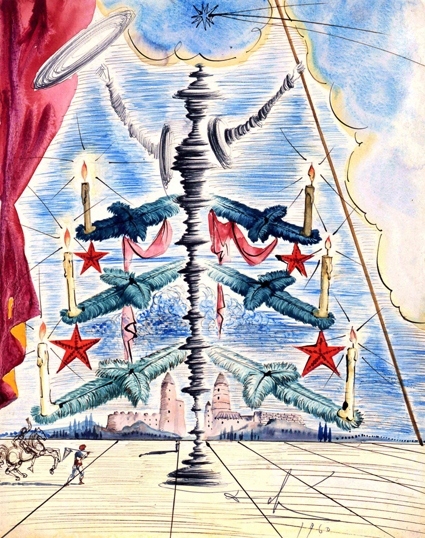
In the 1960 Christmas Card “Don Quijote de la Mancha”, the Christmas Tree structurally becomes the shadow or body shape of Cervantes’s caballero andante. For Dalí, Quijote symbolised the paranoiac-critical method in action: the ability to perceive reality through the prism of one’s own fervent imagination.
.
.
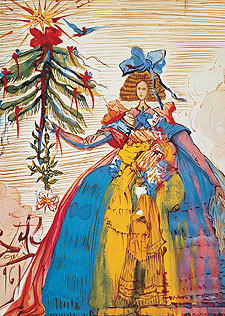
In the 1961 Christmas Card “The Infanta and Las Meninas”, the Master of Surrealism pays tribute to Diego Velázquez and his 1656 masterpiece, Las Meninas, a canvas Dalí deeply venerated. In this card, the Infanta Margaret Theresa is at the centre, not in an austere royal hall, but holding a small, radiant Christmas Tree adorned with a luminous star and conspicuous red ribbons.
.
.
Another Dalinian Christmas card illustrates a tree that recalls the theme of dance and the female figure in motion, a recurring motif that spans painting, sculpture, theatre, and film.
Here, the tree is formed by dancing ballerinas whose wide, bell-shaped skirts resemble festive ribbons or branches. This image irresistibly recalls the animated short film “Destino”, a collaboration project between Dalí and Walt Disney, later rediscovered and completed, in which the shadow of a ballerina appears as a bell. It is a totally Dalinian synthesis between physical joy and spiritual mystery, where human architecture merges with nature in an oneiric celebration.
.
.
Dalí was convinced that art must shock and, at the same time, reveal the depths of the unconscious. In an interview with Alain Bosquet, Dalí reflected on his method: “I think that dreams are a gateway to our unconscious mind… By paying attention to our dreams and exploring their symbolism, we can gain a deeper understanding of our subconscious thoughts and desires”.
This maxim is the key to interpreting his Christmas Cards: the Christmas tree is never just a tree. It is a puzzle to be deciphered, as in many of his paintings and sculptures, a manifestation of the artist’s fears, desires, and memories.
Through his Christmas Cards, Dalí was not merely sending greetings, but a fragment of his inner universe, proving that even in the smallest format, his genius remained monumental.