
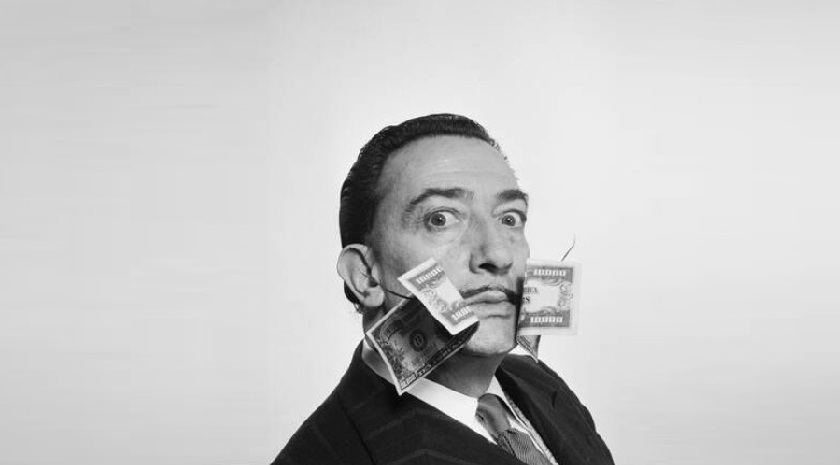
“Very few people know who I really am”, Salvador Dalí once remarked, his eyes gleaming with the calculated madness that had become his global trademark.
By the mid-1940s, the Master of Surrealism had transcended the boundaries of traditional artistry to become a living icon, a brand so potent that his signature alone could validate the most mundane objects.
This was the era of “Avida Dollars”, the scathing anagram André Breton coined in 1942 to mock Dalí’s perceived greed. Yet, in typical Dalinian fashion, the artist didn’t shrink from the title; he wore it like a crown of solid gold.
By the time Salvador Dalí reached his mid-forties, his public persona was no longer a mask, it was an organ. His flamboyant regalia, the enormous waxed moustaches, and the silver-topped cane were part of a ritualised showmanship.
As a contemporary observer noted in 1970, “forty years after his soft watches drooping over a barren landscape made him famous, Dalí is still Everyman’s idea of the mad genius of modern art, and mad genius sells like nothing else”.
Dalí understood a truth few artists dared to admit: image is the ultimate currency. He reached a stage where his artistic signature was so recognizable that his name became unnecessary.
By 1970, Dalí was earning half a million dollars annually after taxes, commanding $50,000 for a single portrait. He sold to the titans of industry, Heinz, Hartford, and Ricard. When Paul Ricard arrived by yacht to Cadaqués for a simple watercolor, he left having paid $280,000 for the mammoth 11′ by 14′ canvas, Tuna Fishing.
The scale of Dalí’s commercial success was nothing short of monstrous. He was a one-man Renaissance factory, echoing the industriousness of Michelangelo or Titian.
“At any given moment there may be hundreds of people working on Dalí artifacts”, reported Life magazine. His creative spirit was distilled into a dizzying array of products: shirts, ties, cognac bottles, stamps for Guyana, and even gilded oyster knives.
In the Aubusson factory, dozens of women wove gold threads into his tapestries. In Nancy, glassblowers crafted his visions into tableware. At the Paris mint, craftsmen struck medals designed by him, medals the French bought as “insurance against hard times”. It was a staggering evolution from the early days when Gala would trudge through the streets of Paris, desperately trying to find a buyer for a single work.
To Dalí, money was the result of an alchemical process, the transformation of base matter into spiritual substance. He drew a profound, almost mystical link between biological energy and financial accumulation.
The headquarters of this financial empire moved seasonally between the St. Regis in New York and the Hotel Meurice in Paris. The lobbies were perpetually crowded with “anonymous-looking businessmen with attaché cases”, waiting for a piece of the Dalí magic.
Out of hundreds of proposals, only a few dozen would reach fruition, such as the famous 1970 commercial where Dalí rolled his eyes and declared, “I am mad. I am completely mad… over Lanvin chocolates”. He was paid $10,000 for fifteen seconds of “madness”.
His negotiations were legendary for their theatricality. Dalí would “crétinise” those around him to maintain control. When a questioner at the Meurice asked why he provoked people, he replied that idiocy was the thing to cultivate. When asked why he told monstrous lies, he countered: “I am here to confuse and cloud the issue, you to put matters straight”.
At the center of this whirlwind was Gala, the “axis upon which the Dalinian world rotated”. She was the gatekeeper, the negotiator, and the pragmatic enforcer.
While Dalí played the “mad genius”, Gala was the one who asked the hard questions. To the filmmakers wanting to capture Dalí’s entrance with a baby panther, her response was a cold lesson in economics: “Do you know what a good steak costs?”
Gala was often perceived as “mean” or “boorish” by the entourage of starlets, hippies, and models that surrounded them, but her role was essential. She was the one who turned back presents she deemed insufficient and ensured that even the most prestigious dealers remained “on their toes”. Yet, beneath the professional ruthlessness, the bond was absolute. They remained “mon petit” and “ma petite” to each other until the end.
The success of Avida Dollars was fueled by a symbiotic relationship with the media. Reporters needed his outrages for headlines, and Dalí needed the headlines to feed the “circular progression” of his fame.