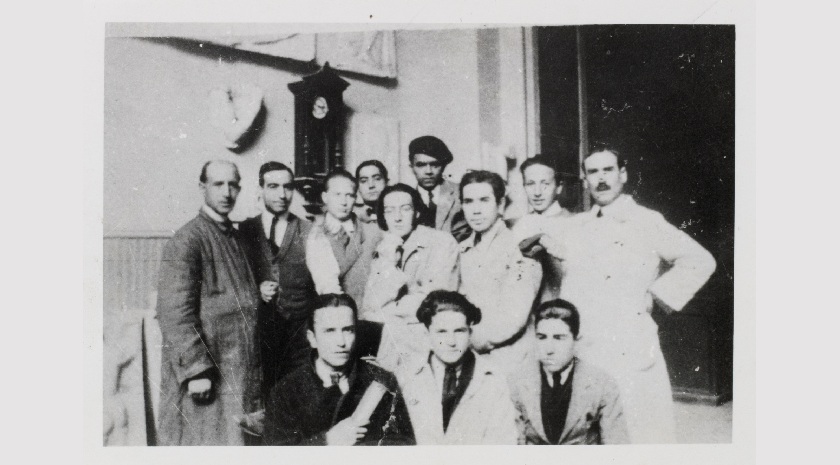
This year, the art world celebrates an unusual, almost paradoxical, yet utterly monumental anniversary. Exactly one hundred years ago, in 1926, a young Salvador Dalí was permanently expelled from the Real Academia de Bellas Artes de San Fernando in Madrid.
The reason? The twenty-two-year-old from Figueres looked the examination committee, academics and professors of renowned reputation, straight in the eye and declared with icy, absolute certainty that “none of them were competent enough to judge his genius”.
Where an expulsion would have meant failure and the end of a career for anyone else, for Dalí, it was the true birth of his myth.
One hundred years later, that resounding rebellion against academic constraints remains the pillar of his immortality. Dalí did not need the Academy; it was the Academy that was dramatically lagging behind the future he was already painting.
In his autobiography The Secret Life of Salvador Dalí, the Master of Surrealism crystallised this moment of rupture not as an act of childish arrogance, but as a logical and inevitable consequence of his intellectual superiority.
Dalí describes the art history exam that led to his final banishment. He was supposed to draw lots for three questions on an artist (Raphael), but he refused to answer: “I am infinitely more intelligent than these three professors, and I therefore refuse to be examined by them. I know this subject much too well”.
Later, reflecting on the rigid academic discipline that attempted to imprison his style, Dalí wrote: “The academy wanted to teach me to see the world through the dusty spectacles of the past. But my eyes were already tuned to the frequency of the subconscious. My expulsion was not a punishment; it was my liberation”.
In his Diary of a Genius, where Dalí analyses his spiritual and artistic evolution, he reinterprets that 1926 event in the light of his global success, proving that his “rejection” of school was the fuel for his ascent toward excellence: “The day I was expelled from San Fernando, I understood that to be unique, one must have the courage to be considered monstrous or intolerable by the surrounding mediocrity”.
And he adds one of his most famous maxims on ambition, which perfectly aligns with his departure from the university: “Since my earliest childhood, I have had the vice of considering myself different from ordinary mortals. And I must say that this vice has brought me magnificent success”.
Today, walking through the Dalí Universe Collection, surrounded by the melting clocks that defy the laws of physics, the majestic elephants balancing on impossibly spindly legs, and the bronze snails celebrating the soft, spiral geometry of the subconscious, we fully comprehend the value of that 1926 refusal.
If Dalí had listened to his professors, today we would not have his famous “Paranoiac-Critical Method”. If he had bowed to academic competence, Surrealism would have lost its most lucid and geometrically anarchic mind.
This year, we celebrate one hundred years of that marvelous “no”. Because, as time has proven to us, genius does not follow pre-written rules: it is born when an artist has the courage to challenge the boundaries of the visible world and create a totally new vision.