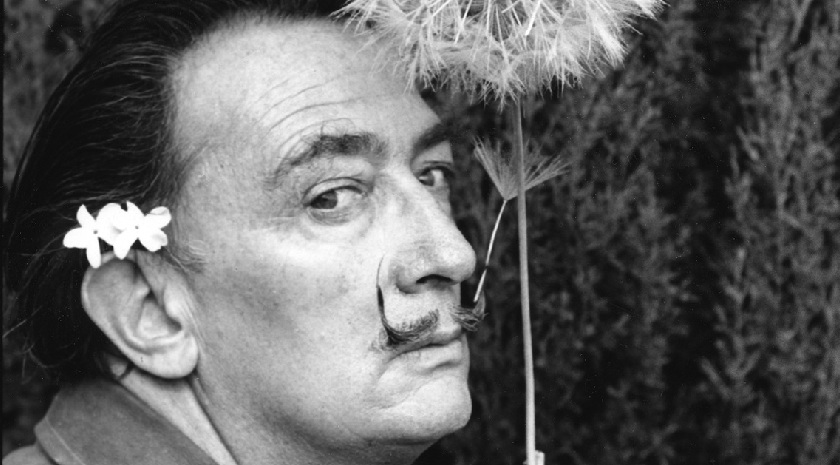
“America is the only country in the world making enormous advances in the technology of science. Cybernetics is close by. And at this very moment in New York, people are working on my earthly immortality. Hibernation specialists are preparing complicated cylinders to lengthen my life expectancy greatly. I’m only human”.
Salvador Dalí
.
While Dalí’s roots were firmly planted in the soil of Figueres, his eyes were often turned toward the Atlantic. To Dalí, the United States was not just a market, but the forge of the future. He saw America as the only stage large enough to host the triumph of science over biological decay.
Dalí’s admission of being “only human” contrasted sharply with his Herculean effort to use technology to bypass the grave. His interest in hibernation and cryogenics was a recurring theme; for Dalí, the computer (cybernetics) and the freezer were as much tools of art as the paintbrush, both serving a singular goal: the achievement of eternal life.
This week, the world commemorate the anniversary of the passing of Salvador Dalí. It was on January 23rd in 1989, at the age of 84, that the eccentric Catalan Master departed from the physical realm.
Yet, for a man who spent his entire life obsessed with “the conquest of death”, this date does not represent an end, but rather the ultimate “transition”, a concept he found perfectly mirrored in the harmonic progressions of Richard Wagner.
As we reflect on his final moments, we recall Dalí in his room at the Torre Galatea, surrounded by the echoes of Wagner’s Tristan und Isolde. Dalí was deeply moved by Wagner’s mastery of the “subtle transition”. He often quoted the composer’s reflection on the Act II scene: “The beginning of this scene represents the most impetuous vitality… the conclusion, the most solemn, intimate desire for death”.
For Dalí, death was not a sudden rupture but a gradual, calculated movement from one state of being to another. Just as the music flows from turbulent passion to a profound stillness, Dalí viewed his life and art as a bridge toward immortality. He did not simply die; he transitioned into his own myth.
“I believe in general in death, but in the death of Dalí, absolutely not”, declared Salvador Dalí.
Dalí’s obsession with eternal life was not merely poetic; it was quasi-scientific and deeply philosophical. In his celebrated work “Ten Recipes for Immortality” (Dix Recettes d’Immoralité), published in 1973, Dalí explored the various paths to defeating time through a series of extraordinary graphics and pop-up constructions.
Through these graphics, Dalí invites us into his laboratory of the mind. He investigated “Stereoscopy”, the creation of three-dimensional space to trick the eye, as a metaphor for reaching a higher dimension. In these illustrations, the Master of Surrealism utilised drypoint etching, heliogravure, and even incorporated plastic materials to challenge the flat constraints of the paper.
For Dalí, immortality could be achieved through the “genetic code” (DNA), through the “perpetuation of the soul” in art, and through the “biological resurrection” of his own persona.
The graphics of “Ten Recipes for Immortality” are not merely illustrations; they are talismans. One work features the “Hypercubic Body”, a nod to his interest in the fourth dimension, while others delve into the “immortality of the soul” via the study of the double helix. Dalí understood that if science could decode the blueprint of life, then art could preserve its essence forever.
“The landscape of immortality is a landscape of rigorous and cerebral geometry, where the soul finds its definitive structure”, wrote Dalí.
In the iconography of the Dalí Universe Collection, the butterfly holds a position of sacred importance, featuring prominently within the visual language of his quest for eternal life. Much like the transition in Wagner’s opera, the butterfly represents the supreme metamorphosis. It is the fragile yet powerful soul emerging from the chrysalis of the mortal body.
Dalí utilised the butterfly to represent the lightness of thought and the possibility of rebirth. This is seen vividly in his graphic works and sculptures, such as “Man with Butterfly” or the ethereal figure in his “Lady Godiva with Butterflies”.
In the context of his death, the butterfly serves as the perfect emblem: the physical artist may have withered, but the “Dalinian” spirit has taken flight, spreading its iridescent wings across the history of modern art.
The “Ten Recipes for Immortality” also highlight Dalí’s fascination with the pentagonal dodecahedron. To Dalí, geometry was the language of the Divine. By mastering these forms in his graphics, he believed he was speaking the dialect of the universe, a language that does not decay with time.
Each “recipe” in the portfolio serves as a different philosophical anchor. Whether discussing the “immortality of the blood” or the “monarchical structure of the universe”, Dalí was weaving a safety net of symbols to ensure he would never be forgotten.
For the Master of Surrealism, “To be immortal, one must possess the secret of the subtle transition, turning the lead of mortality into the gold of the eternal myth”.
This week, the Dalí Universe commemorates Salvador Dalí’s anniversary not as a mourning of loss, but as a celebration of his art, which was, in itself, a vessel for eternal life. His influence remains immeasurable because he succeeded in his quest: he transformed his personality, his fears, and his genius into an eternal monument.
As the notes of Tristan und Isolde faded in that room in Figueres decades ago, the myth of Salvador Dalí began its eternal resonance. Today, through his works and his profound philosophy, we continue to discover new dimensions of the Dalinian Universe, proving that the Master of Surrealism truly did find the secret to eternal life.