“Disguise was one of my strongest passions as a child.”
Salvador Dalí
.
With these words from his autobiography, “The Secret Life of Salvador Dalí”, the Master of Surrealism confesses a truth that would define his entire existence.
For Salvador Dalí, life was not a series of random events, but a continuous, meticulously orchestrated Carnival.
As we enter the heart of the Carnival season, we look back at the man who turned the act of “dressing up” into a sacred ritual of self-revelation.
While the world uses masks to hide, Dalí used them to expose the “Paranoiac-Critical” depths of the human spirit.
From his earliest years in Figueres, Dalí understood that the garment was a tool of power. In his autobiography, he recalls the supreme pleasure of transformation. This was not mere play; it was the birth of a monarch.
Whether draped in a makeshift ermine or adorned with paper crowns, the young Dalí was already practicing the art of the “spiritual disguise”.
He theorized that the human being is essentially a “soft structure”, vulnerable and biological, that requires an “armor” to face the world.
Undoubtedly, one of the most extravagant manifestations of this passion for disguise occurred when the Catalan Master prepared for his first encounter with Gala, the woman who would become his “Gradiva” and his ultimate victory.
Dalí did not merely “get dressed” to encounter Gala; he underwent a profound biological metamorphosis. He approached his own reflection with the same obsessive precision he applied to a canvas, orchestrating a ritual of appearance that blurred the line between the divine and the barbaric.
In a gesture of radical elegance, he took a pristine silk shirt and intentionally shredded it, wearing the fabric open to the elements to expose his chest, a calculated act of vulnerability and strength.
Over this, he draped a heavy, theatrical mantle, a “mantle of greatness” that commanded the air around him. Even under the sweltering heat of the Mediterranean summer, he wore this cape with the solemn gravity of a Renaissance prince or a mystical prophet.
To complete this living sculpture, Dalí adorned himself with long, clinking necklaces that sang with every movement, creating a rhythmic, metallic music. Most surreal of all was his olfactory “aura”; he smeared his body with a pungent mixture of goat glue and lavender, a sensory contradiction designed to be simultaneously attractive and repulsive.
For Dalí, these were not costumes; they were biological necessities. He wrote: “Every morning when I wake up, I again experience a supreme pleasure: that of being Salvador Dalí”. The clothes were the skin of that pleasure.
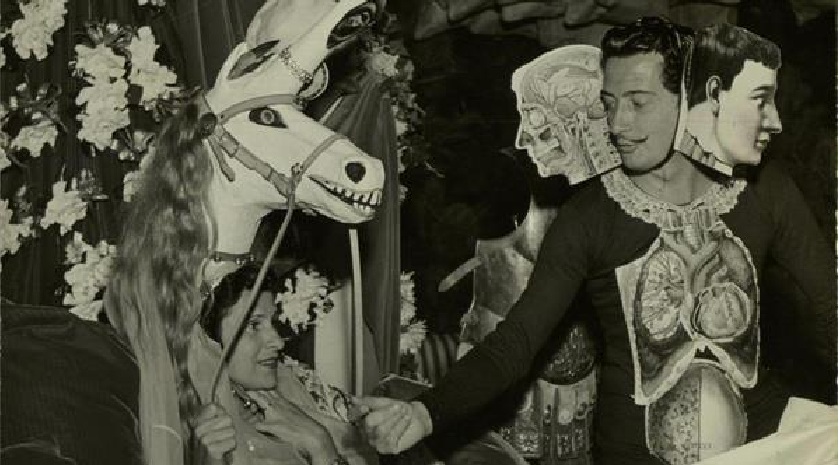
The relationship between Dalí and the aesthetic of Carnival is a journey through the grotesque and the fantastic. From his collaboration with Philippe Halsman in the iconic “Dalí Atomicus” (1948), capturing the chaotic, suspended energy of a festive masquerade, to the legendary 1941 ball, “A Night in a Surrealist Forest”.
At that ball, Dalí transformed a party into a three-dimensional nightmare-dream. Gala appeared in a bed, wearing a stuffed lion’s head, while guests moved among shattered mannequins and tables supported by human legs.
Here, Salvador Dalí conveyed his deeply personal philosophy: one should not dress as a clown, but as a “dream of an apple falling on a piano”.
Even when stripped of his capes and necklaces, Dalí wore a permanent mask: his mustache. He viewed it as a performative accessory, famously stating: “I am a permanent disguise. I wear my mustache as antennas to capture reality, and my clothes as if they were the skin of a divine reptile”.
He even carried a jewel-studded case filled with spare mustaches to offer to friends, proving that the masquerade is a gift to be shared.
To Dalí, the only difference between himself and a madman was that he was not mad; he chose to live the Carnival every single day.