
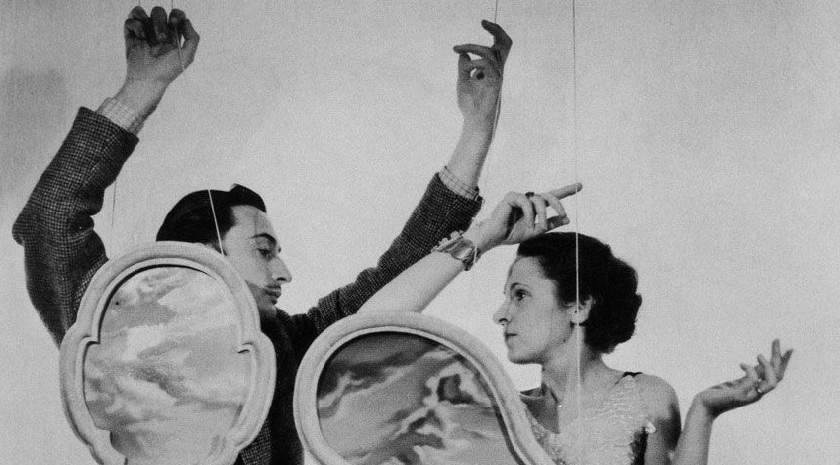
“Gala, the most visible falling star, the most clearly outlined and the most finite”. These words, written by Salvador Dalí, do not merely describe a wife or a muse; they define the very axis upon which the Dalinian world rotated.
To understand Dalí, one must first decode the enigma of Gala, the woman he claimed to love “more than mother, more than father, more than Picasso, and even more than money”.
In the high-octane atmosphere of Surrealism, Gala was the stabilizing force. Dalí himself famously articulated her essential role: “The paranoiac-critical method functions only on condition that it possesses a soft motor of divine origin, a living nucleus, a Gala”.
She was the “Gradiva” of his life, the one who moves forward, stepping out of the pages of Wilhelm Jensen’s novel to cure the young artist of his incipient madness and hysterical laughter.
Born Elena Ivanovna Diakonova in Kazan in 1894, her Russian roots instilled in her a secretive, intuitive nature. After a youth spent in the intellectual circles of Moscow and St. Petersburg, a bout of tuberculosis led her to the Clavadel sanatorium in Switzerland in 1912.
It was there, amidst the alpine air, that she met the poet Paul Éluard. Their union was forged in a shared passion for literature, leading her to Paris in 1916. By 1917 they were married, and in 1918, their daughter Cécile was born. Yet, Gala was never destined for the domesticity of the bourgeoisie; she was the “Sacred Beast” of the Surrealist circle, even engaging in a legendary ménage-à-trois with the artist Max Ernst.
The seismic shift occurred in 1929. When Gala arrived in Cadaqués with Éluard and René Magritte, she found a young Dalí balanced on the precipice of genius and insanity. Despite a ten-year age gap, the recognition was instantaneous.
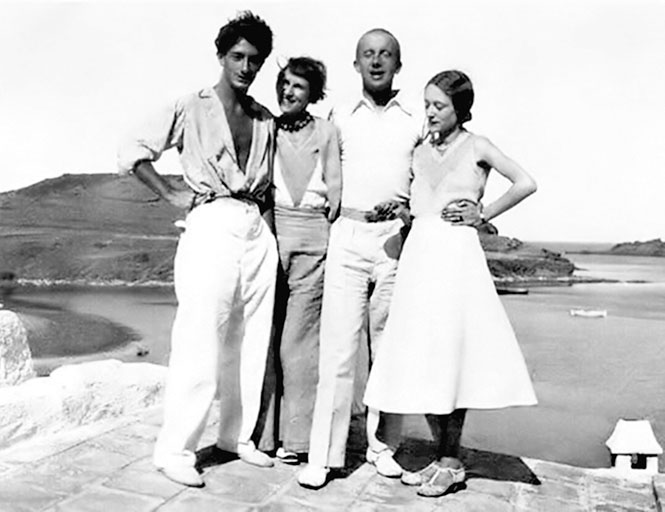
As Dalí recounted in The Secret Life of Salvador Dalí, he recognized her by the “maternal and courageous” anatomy of her back. She became his “Victory”, the woman who would exorcise his demons and channel his chaotic energy into meticulous canvases.
Their bond was so absolute that it necessitated a ruthless shedding of the past; Gala eventually distanced herself from her daughter to become the permanent fixture at Dalí’s side. They wed in a civil ceremony in 1934, a union initially loathed by Dalí’s father, who viewed the Russian divorcee as a predatory influence. To Dalí, however, she was the “Galarina”, the subject of his 1945 masterpiece, which he labored over for a year to capture her spiritual and physical essence.
By 1937, Gala had transitioned from inspiration to institution. She was the “soft motor” that handled the hard realities of the art world. As Dalí’s business manager, she negotiated contracts with a ferocity that earned her both respect and notoriety.
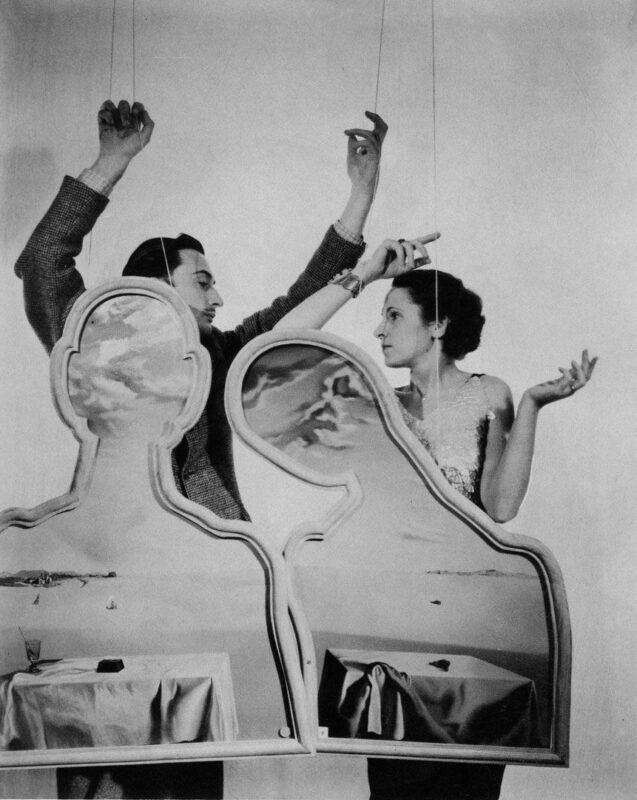
In Diary of a Genius, Dalí notes that she was the one who kept him tethered to the easel: “She is the only one who knows how to transform my ‘excrement’ into gold”.
Their spiritual journey culminated in 1958 with a Catholic wedding in Girona, solidifying their “mystical” union.
As the decades passed, Gala’s role evolved. In 1968, Salvador Dalí gifted her the Castle of Púbol, a medieval retreat where he could only visit her upon receiving her written permission. This courtly arrangement reflected the sovereign status she held in his life; she was his queen, his judge, and his sanctuary.
Gala was more than a model; she was a co-author of the Dalí brand. She was the “Angel of the Anchor”, the woman who prevented the artist’s ship from drifting into the void.
When she passed away in 1982, the “soft motor” of the Dalinian Universe finally stopped. For the world, she remains an enigma, a woman of steel and intuition who realized that to be the muse of a genius, one must first be a genius of management.
“The paranoiac critical method functions only on condition that it possesses a soft motor of divine origin, a living nucleus, a Gala”.
Salvador Dalí