
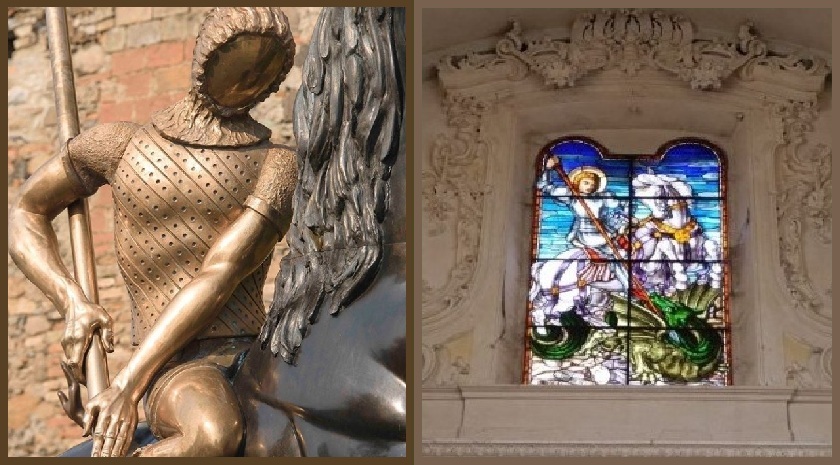
“I am surrealism… And I believe it, because I am the only one who is carrying it on. I have repudiated nothing; on the contrary, I have reaffirmed, sublimated, hierarchised, rationalised, dematerialised, spiritualised everything. My present nuclear mysticism is the ultimate harvest, inspired by the Holy Ghost, of the demoniacal and Surrealist experiment of the first part of my life”.
Salvador Dalí
.
The bronze sculpture “Saint George and the Dragon” has been ceremoniously selected by the Dalí Universe as the centerpiece of the upcoming exhibition “Salvador Dalí. Avida Dollars – Science and Faith”.
This exclusive event is destined to transform the architectural and cultural landscape of Sassuolo, Modena, offering a curated journey into the complex dualities of the Catalan genius.
The exhibition explores the electric friction between Dalí’s obsession with material success, satirically mocked by André Breton through the anagram Avida Dollars, and the artist’s profound, late-career devotion to nuclear physics and Catholic mysticism.
Chosen for its deep resonance with the local identity, as Saint George is the revered patron saint of Sassuolo, this bronze masterpiece serves as the definitive bridge between Dalí’s universal surrealist language and the historical heart of the city.
Throughout the annals of art history, the struggle of Saint George has been immortalised by masters such as Giotto, Raphael, and Paolo Uccello. Yet, in the hands of Salvador Dalí, this traditional martyrdom is transfigured into a symbolic psychoanalysis of the human condition.
.
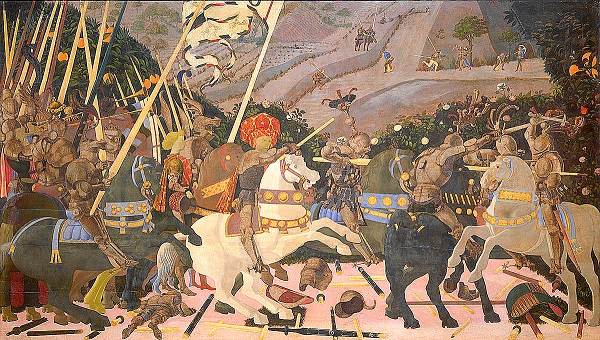
.
Dalí’s Saint George is far more than a simple knight; he is a “gallant horseman in shining armor”, captured at the precise, frozen moment of triumph over the primordial forces of evil.
The artist’s fascination with the Renaissance was not just an academic interest; it was a spiritual obsession. “If I look toward the past”, Dalí wrote in The Secret Life, “beings like Raphael appear to me as true gods”.
.
.
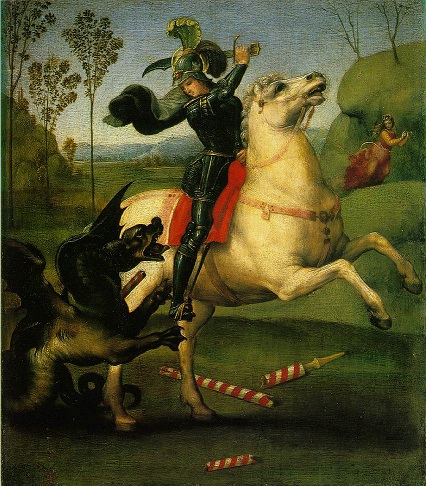
This specific bronze work maintains a direct aesthetic bridge to Raphael’s 1505 masterpiece in the Louvre. While both works share a dynamic diagonal composition, Dalí transfigures the subject through his signature “Nuclear Mysticism”.
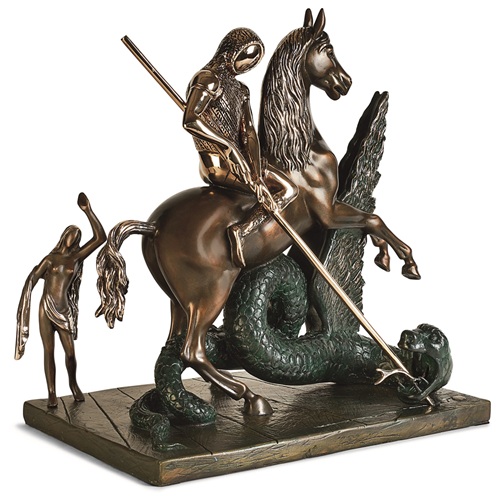
Where Raphael uses a lance to pin the beast, Dalí emphasises mathematical precision, creating a compositional balance where the thin lance forms an ideal diagonal rising from the dragon’s head, through the knight’s arm, and extending toward the faceless Princess of Selene.
.
.
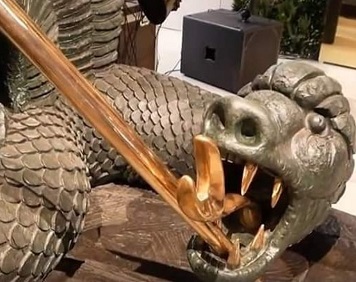
In the quintessential Dalinian vision, the sculpture is a theater of transformation. The dragon’s wings do not simply flutter; they erupt into flickering flames. Most strikingly, the dragon’s bifurcated tongue morphs into a crutch, one of Dalí’s most potent and recurring symbols.
For the Catalan artist, the crutch represented “the symbol of death and the symbol of resurrection”, an object of “supreme authority” discovered in a country attic during his youth. By converting the beast’s weapon into a support of authority, Dalí illustrates the necessity of the “symbolic death” of our inner obsessions to reacquire a new, balanced life.
The tactile nature of the bronze reveals Dalí’s manic attention to detail. The dragon’s skin is rendered with the scales of a fish, a profound nod to his Diary of a Genius, where he recalled a hallucinatory episode believing he was turning into a shimmering fish.
Furthermore, the shiny finish of the knight’s armor and the dragon’s tongue reflects the Dalinian philosophy that “Glory is a shiny, pointed, cutting thing”.
.
.
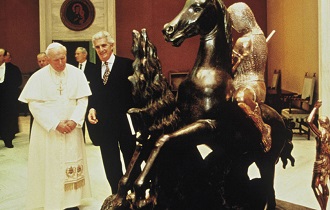
This sculpture carries an immense weight of spiritual history. Since 1995, a museum-sized bronze of this work has resided within the Vatican Museums as a gift from the Dalí Universe to Pope John Paul II. Its presence in Sassuolo brings a fragment of that Apostolic Roman glory to the province of Modena.
.
.
Dalí spent his existence searching for Heaven, which he concluded was found “exactly in the center of the bosom of the man who has faith”. In his sculpture “Saint George and the Dragon”, the warhorse does not recoil in terror; instead, it draws vital energy from the very flames of the dragon, channeling that courage directly to the knight.
“At the very moment when Breton did not want to hear any more about religion, I was preparing, of course, to invent a new religion which would be at once sadistic, masochistic, and paranoiac”.
Salvador Dalí
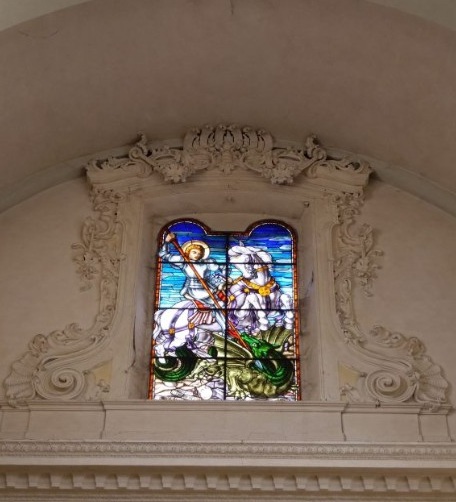
Detail of the main entrance door featuring the stained-glass window depicting Saint George on horseback as he slays the dragon.